
In the News: Bolinas land trust buys former Tacherra Ranch
by Ben Stocking for the Point Reyes Light
Por favor, consulte abajo la traducción al español.
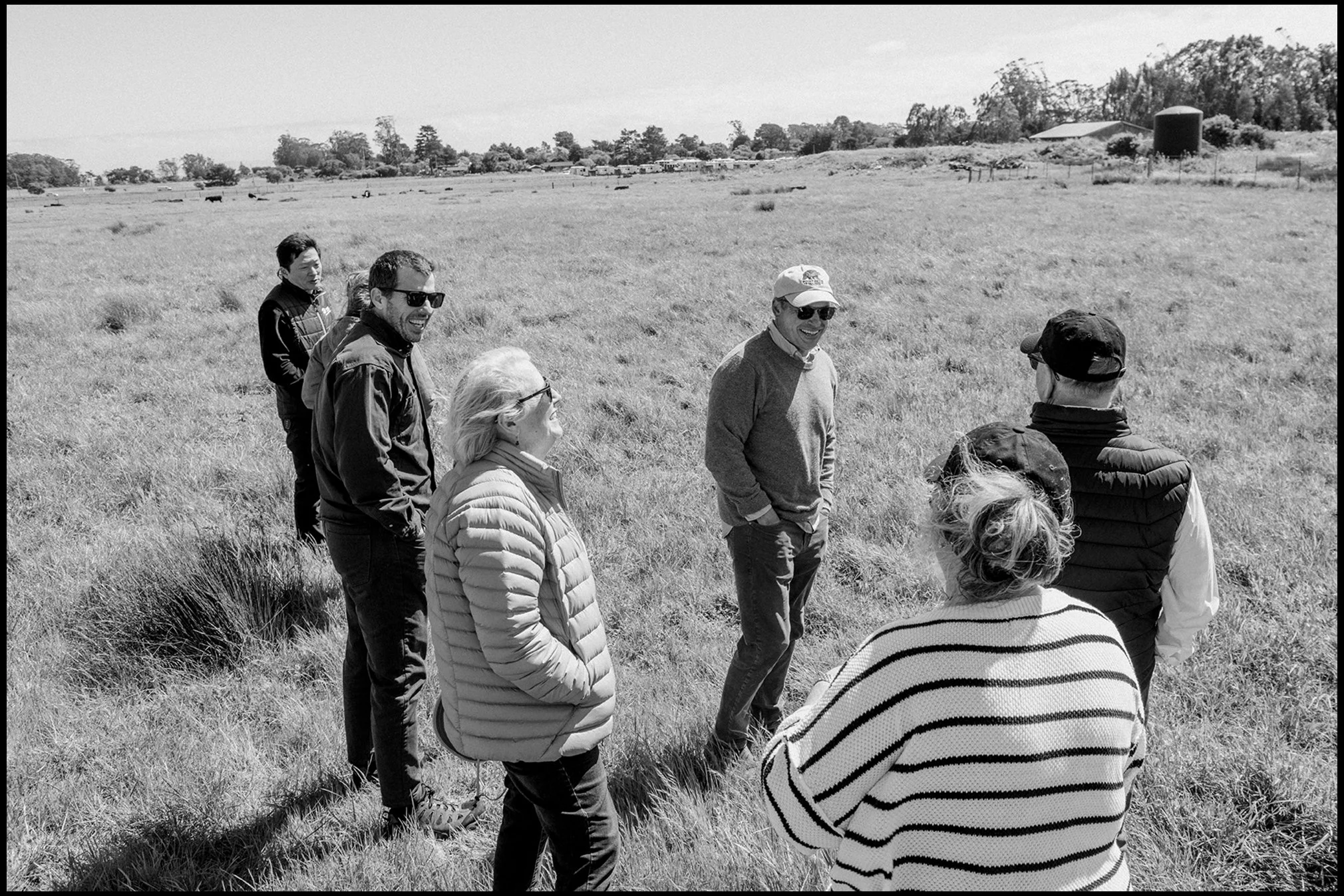
Local and regional affordable housing developers visited a newly purchased 46-acre property in Bolinas on Tuesday. (David Briggs / Point Reyes Light)
The Bolinas Community Land Trust has completed its purchase of the Tacherra ranch, marking a milestone in a broad-based effort to build permanent, affordable housing for about 60 longtime residents who were displaced from condemned housing at the site.
The trust signed a purchase-and-sale agreement for the 46-acre property two years ago but had been negotiating since then over the extent and cost of remediating the land, part of which had been used as an unpermitted dump for years.
The parties closed the deal on March 6 at a price of $3 million, according to Larry Baskin, the court-appointed receiver who had been managing the property until the sale. The ranch had been appraised at $3.75 million, but the land trust received a credit of $720,000 to cover the costs of soil testing and cleanup.
“We are thrilled to create this opportunity for Bolinas families to put down long-term roots by securing affordable homes,” said Jeffrey Clapp, co-director of the land trust. “This effort is about ensuring that Bolinas remains a place where working families can truly belong.”
The trust has been eyeing the ranch as a site for permanent affordable homes for many years, and it purchased a 20-acre portion of the property in 2018. It opened a temporary R.V. park, now known as Bo-Linda Vista, in 2023 to house the displaced residents. Forty-six people from 23 households are living there while they wait for permanent housing.
Most Bo-Linda Vista residents have lived in Bolinas for years, and some have been in town for decades. Their children make up nearly 25 percent of the student body at the local school, and they are key contributors to the local workforce.
Now that the land trust has secured all 66 acres of the ranch, it plans to build as many as 27 new homes there, with priority given to residents of Bo-Linda Vista. The housing will be located on a roughly six-acre area where the substandard housing previously stood.
Some of the housing will stand on three acres next door to the Tacherra ranch, on land recently donated to the trust by John Osterweis, a financial manager and philanthropist. “Bolinas, like a lot of other places around the country, has a housing crisis, and there isn’t sufficient affordable housing for people who are vital to the community,” Mr. Osterweis told the Light. “We had some extra pastureland, and it was very useful for the B.C.L.T. project so I was happy to donate it.”
The trust will now begin predevelopment work, consulting with the county to determine the allowable scope of construction and to obtain the required permits. It plans to consult with community members before settling on a design and hopes to have the homes ready within three to five years. Habitat for Humanity San Francisco, which is collaborating with the trust on a downtown project, will provide technical support.
On Saturday, the land trust is throwing itself a 40th birthday party, and it will have much to celebrate, said Annie O’Connor, a co-director who played a key role in the Bo-Linda Vista project.
“This acquisition is the largest in the B.C.L.T.’s history, and it affirms something that we’ve always believed—that community ownership of land is one of the most powerful tools we have for keeping a community full,” she said.
The county condemned 23 ramshackle structures on the former Tacherra ranch in 2020, declaring them unsafe and unfit for habitation due to failing septic systems, unhealthy drinking water, faulty electrical connections and other violations. The residents moved out three years later and the structures have since been removed.
The ranch purchase was made possible by bridge loans from two anonymous local families and the Pincus Family Fund, which was founded by Mark Pincus, a tech entrepreneur who lives in town. The land trust is seeking another $13.3 million to complete the infrastructure for the permanent housing and to continue operating Bo-Linda Vista until the permanent homes are built.
Although the precise layout and design of the homes has not yet been determined, they will be single-family houses, not multi-unit apartment buildings, Mr. Clapp said. “We are really focused on keeping them in character with the rest of the Bolinas mesa,” he added.
When the new construction is complete, the 23 R.V.s at Bo-Linda Vista will be removed, restoring the meadow at 130 Mesa Road, a property that abuts Mesa Park and the fire station.
The project has received strong support from both state and county officials, who have provided millions of dollars in funding, as well as Bolinas residents. But the effort has not been without opposition. A group called Bolinas for Compassionate Land Use appealed the permits to the California Coastal Commission and then filed suit after they were approved.
Azucena Vazquez, who lives at the R.V. park with her husband and two daughters, is eager to see the project move into its next phase. “After everything we’ve been through, this project is important to me, my daughters and my husband because we want to feel like nobody can displace us,” she said. “We’ll have a real home and a safe space.”
After the receiver and any outstanding taxes are paid, the Tacherra family will receive their share of the sale proceeds, Mr. Baskin said.
Jim Tacherra, the third generation of his family to farm at the ranch, will continue grazing cattle there with the B.C.L.T. as his landlord. Mickey Murch, who lives on nearby Gospel Flat Farm and grows vegetables on a section of the former Tacherra ranch, will also stay on.
In fact, the land trust envisions an agricultural cooperative at the site, with more farmers growing crops there. In addition, a community garden at Bo-Linda Vista may be expanded and opened to other Bolinas residents. There is already a pond on the ranch that would provide water for any future crops or forage, Ms. O’Connor said.
The ranch purchase closes a chapter on a saga that lasted years as family members sorted through legal and financial disagreements and accumulated code citations from the county. It has been 14 years since Mr. Baskin was appointed as a receiver to take over management of the property, settle its debts and sell it on behalf of the Tacherras.
“I’m happy that the land trust finally acquired the ranch and is going to use it for a good purpose,” he said. “It was a difficult, lengthy transaction because of the unique nature of the property and its occupants. But in the end, the transaction closed, the title was transferred, and I have nothing to do with the property. I’m happy about that.”
por Ben Stocking para el Point Reyes Light
Desarrolladores de vivienda accesible de la zona y de la región recorrieron el martes el terreno de 46 acres recién adquirido en Bolinas. (David Briggs / Point Reyes Light)
El Fideicomiso Comunitario de Tierras de Bolinas cerró la compra del rancho Tacherra, un paso importante dentro de un esfuerzo más amplio para construir viviendas permanentes y accesibles para cerca de 60 residentes de muchos años, quienes fueron desalojados de casas condenadas en el mismo terreno.
El fideicomiso firmó el contrato de compraventa de la propiedad de 46 acres hace dos años, pero desde entonces estuvo negociando el alcance y el costo de la remediación del terreno, pues parte del rancho se usó como tiradero clandestino durante años.
Las partes cerraron el trato el 6 de marzo por un precio de 3 millones de dólares, según Larry Baskin, el síndico designado por el tribunal que estuvo a cargo de la propiedad hasta la venta. El rancho estaba avaluado en 3.75 millones de dólares, pero al fideicomiso le otorgaron un crédito de 720,000 dólares para cubrir los gastos de análisis de suelo y limpieza.
"Estamos muy contentos de poder crear esta oportunidad para que las familias de Bolinas echen raíces a largo plazo con viviendas accesibles", dijo Jeffrey Clapp, codirector del fideicomiso. "Este esfuerzo se trata de asegurar que Bolinas siga siendo un lugar donde las familias trabajadoras realmente puedan pertenecer".
El fideicomiso tenía puesta la mira en el rancho desde hace muchos años como posible sitio para vivienda accesible permanente, y en 2018 adquirió una porción de 20 acres del terreno. En 2023 abrió un parque temporal de casas rodantes, hoy conocido como Bo-Linda Vista, para albergar a los residentes desalojados. Actualmente 46 personas de 23 hogares viven ahí mientras esperan una vivienda permanente.
La mayoría de los habitantes de Bo-Linda Vista llevan años viviendo en Bolinas, y algunos han estado en el pueblo por décadas. Sus hijos representan casi el 25 por ciento del alumnado de la escuela local y son parte fundamental de la fuerza laboral de la comunidad.
Ahora que el fideicomiso ya tiene las 66 acres completas del rancho, planea construir hasta 27 casas nuevas, dando prioridad a los residentes de Bo-Linda Vista. Las viviendas se ubicarán en un área de aproximadamente seis acres, donde antes estaban las casas en malas condiciones.
Parte de las viviendas se construirán en tres acres contiguos al rancho Tacherra, en un terreno donado recientemente al fideicomiso por John Osterweis, administrador financiero y filántropo.
"Bolinas, como muchos otros lugares del país, tiene una crisis de vivienda, y no hay suficientes casas accesibles para la gente que es esencial para la comunidad", dijo Osterweis al Light. "Teníamos un terreno de pastoreo que no estábamos usando y le caía muy bien al proyecto del B.C.L.T., así que con gusto lo doné".
El fideicomiso ahora comenzará los trabajos de predesarrollo, en consulta con el condado para definir el alcance permitido de la construcción y obtener los permisos requeridos. Antes de decidir el diseño final, piensa consultar con la comunidad, y espera tener las casas listas en un plazo de tres a cinco años. Habitat for Humanity San Francisco, que ya colabora con el fideicomiso en otro proyecto en el centro, brindará apoyo técnico.
Este sábado, el fideicomiso celebrará su 40 aniversario con una fiesta, y tendrá mucho que festejar, dijo Annie O'Connor, codirectora que tuvo un papel clave en el proyecto de Bo-Linda Vista.
"Esta adquisición es la más grande en la historia del B.C.L.T. y confirma algo en lo que siempre hemos creído: que la propiedad comunitaria de la tierra es una de las herramientas más poderosas que tenemos para mantener viva a una comunidad", señaló.
El condado condenó 23 estructuras en mal estado en el antiguo rancho Tacherra en 2020, al declararlas inseguras e inhabitables por fallas en los sistemas sépticos, agua no apta para consumo, instalaciones eléctricas defectuosas y otras violaciones. Los residentes se mudaron tres años después y las estructuras ya fueron retiradas.
La compra del rancho fue posible gracias a préstamos puente de dos familias locales que prefirieron el anonimato y del Pincus Family Fund, creado por Mark Pincus, un empresario tecnológico que vive en el pueblo. El fideicomiso busca otros 13.3 millones de dólares para completar la infraestructura de las viviendas permanentes y seguir operando Bo-Linda Vista mientras se construyen.
Aunque todavía no se define el diseño exacto de las viviendas, serán casas unifamiliares y no edificios de departamentos, explicó Clapp. "Estamos muy enfocados en que estén en armonía con el resto de la meseta de Bolinas", agregó.
Cuando termine la nueva construcción, las 23 casas rodantes de Bo-Linda Vista serán retiradas y se restaurará el prado del 130 de Mesa Road, una propiedad que colinda con Mesa Park y la estación de bomberos.
El proyecto ha contado con un fuerte respaldo de autoridades estatales y del condado, que han aportado millones de dólares en financiamiento, así como de los propios vecinos de Bolinas. Pero el esfuerzo no ha estado libre de oposición: un grupo llamado Bolinas for Compassionate Land Use apeló los permisos ante la Comisión Costera de California y después presentó una demanda tras su aprobación.
Azucena Vázquez, que vive en el parque de casas rodantes con su esposo y sus dos hijas, está ansiosa por ver el proyecto avanzar a la siguiente etapa. "Después de todo lo que hemos pasado, este proyecto es importante para mí, para mis hijas y para mi esposo, porque queremos sentir que nadie nos puede desplazar", dijo. "Vamos a tener un verdadero hogar y un espacio seguro".
Una vez que se pague al síndico y los impuestos pendientes, la familia Tacherra recibirá la parte que le corresponde de la venta, dijo Baskin.
Jim Tacherra, tercera generación de su familia en trabajar el rancho, seguirá pastoreando ganado ahí, ahora con el B.C.L.T. como arrendador. Mickey Murch, que vive en la cercana Gospel Flat Farm y cultiva verduras en una sección del antiguo rancho Tacherra, también se quedará.
De hecho, el fideicomiso contempla crear una cooperativa agrícola en el sitio, con más agricultores sembrando en el terreno. Además, el huerto comunitario de Bo-Linda Vista podría ampliarse y abrirse a otros residentes de Bolinas. Ya existe un estanque en el rancho que podría abastecer de agua cualquier cultivo o forraje a futuro, señaló O'Connor.
La compra del rancho cierra un capítulo de una historia que se prolongó durante años mientras los miembros de la familia resolvían desacuerdos legales y financieros y acumulaban infracciones del condado. Han pasado 14 años desde que Baskin fue nombrado síndico para hacerse cargo de la propiedad, saldar las deudas y venderla en nombre de los Tacherra.
"Me da gusto que el fideicomiso por fin haya adquirido el rancho y lo vaya a destinar a algo bueno", dijo. "Fue una transacción difícil y larga por la naturaleza tan particular de la propiedad y de sus ocupantes. Pero al final el trato se cerró, se transfirió el título, y ya no tengo nada que ver con la propiedad. Estoy contento con eso".